Showing posts with label 2015 Megan. Show all posts

Thursday, July 20, 2017

Meghan 2017

Updates:
    As my fellowship winds down I have been compiling data, making a field guide, making a story map, and collecting our traps. In addition, we have also switched over from only collecting males to only collecting females. As the Summer has progressed, females are now molting. We found about 5 or 6 soft shell females at Adam's Point Landing yesterday. Dr. Bradt will be continuing the work with the females for the remainder of the Summer.
    So far we have had 27 molts out of 123 crabs that we put into individual containers. Of these 27, 5 were an orange coloration which was believed to be a terminal molt, however now we know that this isn't always the case. In addition, The size classes that grew the most were crabs with carapaces 1.8 and 2.2 inches prior to molting. There were 5 crabs in each size class that molted. On July 3rd and 4th we had the most crabs molt in one day. On both the 3rd and 4th, 4 crabs had molted. We think that this may have been because of the temperature, which was around 20 degrees Celsius.
    Next year it would be interesting to put go pros in the large tanks so we could actually see the molting process happen. Also, I was asked how many times a Summer green crabs molt and I wasn't sure about the answer. An idea for next Summer is to keep the molted crabs in the tanks and see if they molt again instead of release them or cook them like we did.
    Thank you to NH Sea Grant and the Doyle Fellowship for an awesome experience! Can't wait to see soft shell green crabs on the menu one day!
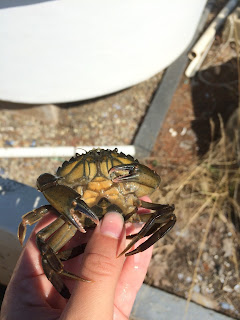
A molted green crab and its orange carapace
Kids in Ogunquit at Footbridge Beach were catching green crabs with nets and using hot dogs as bait
Thank you!

Friday, June 16, 2017

2017 Meghan

Happy Friday! Here are some updates about what I have been up to:
       On a daily basis I check our five crab traps and take all of the crabs inside the trap back to the lab. Our traps are currently located in Seabrook, Hampton, and 3 near the Jackson Estuarine Lab. Once back at the lab, I sort the males and females in order to get a sex ratio from each location. The females I have been giving to an oyster project or to Winn Watson's tank. The males I keep and sort depending on if I think they are premolt or imminent. The premolt, male crabs go inside one tank and the imminent, male crabs go into individual containers that are labelled with the date and numbers. The crabs in the individual containers are photographed every other day in order to see what they look like when they are about to molt. Below is a photo of one of our five traps. 


  In addition to doing sex ratios at each location and seeing the morphological signs of molting, I have also been foraging for green crabs with Dr. Bradt. I even brought a few down to Gloucester where they cooked them for us. Today I brought about 12 soft shell crabs, that I found near the boat ramp on Adam's Point Road, to a restaurant called the Joinery in Newmarket. I watched the chef, Brendan, prepare the crabs by removing their eyes, gills, and sex organs by flipping open the crab's abdomen and cutting it off. Below is a picture of the soft shell crab that was prepared for me at Tonno restaurant in Gloucester. It was fried, put over a relish, and drizzled with spicy mayo-similar to what you are given with sushi.
 -Meghan

Monday, July 27, 2015

2015 Megan: From Green Crabs to Micro Plastics

Hi Everyone!

It’s been a busy summer so far! During the past few weeks I've been continuing to work on both the green crab project and the integrated multi trophic aquaculture project, while also diving into other projects such as a micro plastics monitoring project and a cleanup on Appledore Island. This fellowship has given me the opportunity to learn so much about different sampling methods as well as different experiment approaches.  

Now for the green crab update! So far only one green crab has molted that was not in our experimental group. It was really cool to see the crab just after it had molted - it was very soft and red. However, in just 24 hours the crab already had a fairly hard shell, and after 48 hours the crab had an even firmer shell that was completely green in color! Since the crab becomes firm so quickly, they would need to be flash frozen within the first day of their molting. 
                      
Female Green Crab just after molting
                          
Female Green Crab 48 hours after molting
We are continuing to monitor the crabs in our initial group, but since the crabs haven't molted within the month, we decided to collect a new group and begin the experiment again with new crabs in a separate tank. We made our second group smaller, with 10 control female crabs and 10 experimental (scratched) female crabs because we discovered that working with and observing 50 crabs was too difficult. For this project, it was especially difficult since we need to document and observe morphological features of all crabs in our experiment. Hopefully our second round of the experiment will go more smoothly than our first! We had a few bumps in the road regarding tagging and identification, tank set up and maintenance, crabs becoming gravid and mortality. Working through all of these issues has taught me a lot about the scientific process and thinking outside the box to problem solve.

Mussel line with collected 
spat from last fall
New mussel line
My second update is from the integrated multi trophic aquaculture project! We set out new lines to collect mussel spat with some older lines that already have spat from last fall. The lines should collect the spat within the next few weeks. The Irish moss we collected from Fort Stark has been set out in rope lines to grow vertically, and is doing fairly well. However, it seems the same treatment with Gracilaria does not work well and we lost most of it from falling out of the rope. We are thinking that if we can collect more Gracilaria, we will try growing in a box set up floating at the surface. Since the temperatures have warmed considerably and the trout have gotten much bigger, we transferred them offshore a bit to the UNH aquaculture site. We are continuing to feed them and they will be large enough to sell in a few weeks time!  

Rozalia Project Group and I on Appledore preparing for the clean up  


 Lastly, I've had the opportunity these past couple weeks to work with Gabby Bradt on her micro plastics monitoring project as well as a clean up on Appledore Island! For the monitoring project, samples are collected at the 5 most at risk beaches in New Hampshire (Jenness, Hampton Harbor, Hampton Beach, North Hampton Beach, and Wallis Sands) each month and processed by categorizing any plastic found. Quadrats are set up at the rack line on the beach and sand is run through a series of sieves, down to 1mm. Any plastic is collected from the larger sieves, while all other remnants are left on the beach. After going through the final sieve, all remnants are saved and looked at under a microscope later for categorizing. It was fun to clean up the beach a little, while collecting data so that we will be able to  see a trend in the types of plastics found and their distribution. 

Cleaning up the shoreline of Appledore
Island (note the buoys in the center of the picture)

We also did some plastic clean up on Appledore Island, but instead of micro plastics we were looking for large plastic debris. We spent the day working with a high school group taking a 2-week course on the island, as well as a group working with the Rozalia Project for a Clean Ocean. What was most surprising to me was that the majority of the plastic trash we found was fishing gear; fishing lines, buoys, lobster traps, ropes, and large bits of Styrofoam. Since Appledore is so remote, I had the idea that there actually wouldn’t be very much trash or plastic to pick up. 
However, I quickly saw that this was not the case!


I’m very eager to continue working with both Michael and Gabby on all of these projects and more opportunities to come! This summer has been an absolute blast so far and it’s coming to an end too quickly. Be on the look out for another update coming soon.


Tuesday, June 23, 2015

2015 Megan: First Few Weeks


Hello! My name is Megan Peavey and I will be a senior next fall at the University of New Hampshire studying Marine, Estuarine, and Freshwater Biology. I am very excited to be working with NH Sea Grant as a Doyle Fellow this summer. I am working with two mentors in fisheries and aquaculture – Michael Chambers and Gabriela (Gabby) Bradt. In the first few weeks, I have already learned so much and I’ve started some different projects that I will share with you!


One project I’ve been working on with Michael Chambers and a few others this summer is an integrated multi-trophic aquaculture (IMTA) of rainbow trout, blue mussels, and seaweed at the UNH aquaculture site off the coast of the Coastal Marine Lab in New Castle, NH. The goal of this ongoing project is to investigate sustainable aquaculture practices in the NH area, as well as get local fisherman involved in utilizing aquaculture to augment their wild catch. So far, we have received the fish from the hatchery in Ossipee, NH and placed them within nets we coated with blue “anti-fowling” paint underneath the Judd-Greg Research pier. Using the anti-fowling paint helps prevent other organisms (such as algae, tunicates, bryozoans, etc.) from colonizing on the nets and reducing the efficiency of the system. We feed the fish a moist diet that is designed to help the fish transition from fresh to salt water twice a day. Once the fish get a bit larger, we will transport them to the UNH aquaculture site location.


As for the blue mussel and seaweed components of the project, we are cleaning off old mussel lines and preparing the new ones to collect the mussel spat (mussel larva that has attached to a surface). Sugar kelp is the species of seaweed usually grown and it is a winter crop, meaning it is grown all winter and harvested in the spring. Although sugar kelp grows well in the winter, it doesn’t grow as well in warmer temperatures and too many epiphytes grow upon it during the summer months making it unsuitable for summer. Last week, we collected two types of seaweed from Fort Stark: Gracilaria and Irish Moss. We are investigating the possibility of growing these two species in the summer alongside the blue mussels and rainbow trout.
Gracilaria (thin red seaweed) and
Fucus species (green thicker seaweed)
Irish Moss

With Gabby Bradt, I’ve been working on a project focusing on the European Green Crab (Carcinus maenas). These crabs are an invasive species that were introduced from Europe in the 1800s, and again in the 1900s. By now, they have become well established along the East Coast of the U.S. and are detrimental to our ecosystems here, devastating populations of mussels, clams, and other species. This is not only a problem for ecosystem structure, but also economically for fishermen and clam diggers. The goal of our project is to better understand molting behavior and look for morphological cues for molting in green crabs. With this information, we hope to create something similar to the soft-shell industry for blue crabs. After molting, crabs are in the soft-shell stage, and at this point they are usually fried or cooked in a variety of ways, and eaten. Although this is common practice for blue crabs, it isn’t with green crabs. Since green crabs are fairly small, they are more marketable as a soft-shell crab than a whole crab that a chef would have to pick the meat out of. The idea is that one way to control the population of European Green Crabs would be to eat them, similar to projects in Florida that aim to control lion fish populations that are out of control.

So far we have collected 100 female crabs, and 12 male crabs at the Hampton Public Pier in Hampton, NH to use in our experiment. We are conducting the experiment in two outdoor tanks at the Jackson Estuarine Laboratory in Durham, NH. 50 of the female crabs are in one tank - 25 are controls, with nothing done to them except for tagging, while the remaining 25 have scratched carapaces along with their tags. All remaining crabs (50 females and 12 males) are in a tank together to observe if pheromones from different sexes have any influence on molting.


Green Crab from control group


Trap used for catching crabs @ Hampton Pier
              
Green Crab from experimental (scratched carapace) group

In the past few weeks I’ve learned a lot about experimental design and how to adapt when something doesn’t work or needs to be adjusted. I have also learned all sorts of marine skills from knot tying to net repair, and I’m sure this is only the beginning and it has been a whirlwind first few weeks. Stay tuned for an update on these to projects as well as others to come!