Showing posts with label 2018 - Kristina. Show all posts

Wednesday, August 1, 2018

Crabs, Cruises and Sand Dunes

  Hey guys, I've been busy and haven't updated my blog in a hot minute so here I go...

  Since my last blog post I've been out with Robert (other intern who works with Alyson) collecting green crabs with Gabby's interns Nicole and Mark. Even Peter came out and took some pretty awesome photos of us again (unfortunately I don't have them yet). My fear for crabs has yet to go away but I still tag along for crab hunting and try my best to help out, typically carrying the bucket of crabs and paper work.  So a few days later we ended up giving a presentation for UNH Cooperative Extension about what we've been up to. I haven't gave a presentation in quite some time so of course I was a little nervous, but thankfully it came naturally because I'm talking about something I'm passionate about. If you did want to check it out, you can click here.

  We also went out one early foggy morning to try and do some beach profiling in Hampton. However  fog and looking for the horizon do not go hand in hand. As time went on the fog became thicker and went more inland so eventually we had to give up. I talked about beach profiling in my presentation but if you haven't looked I'll mention it again. It's a technique used to measure the changes in the contour of a beach. We typically use the emery method where we have two rods and line up the rod farther away from the shore with the horizon and line it up with measurement on the rod to capture the change of elevation. The further rod takes the closer rods spot and we repeat the process until we get to the shoreline. It's quite fun and not too hard once you get there hang of it.


Below are some other photos of me beach profiling at one of our sites in Seabrook with some volunteers.


   Roberts main focus for his internship if setting up a protocol to monitor the success of rehabilitated areas/paths in sand dunes. So for a couple days we were back in the dunes laying our transects and collecting data at Harbor Side Dunes in Hampton. We laid out 3 transects in each category, path ways, vegetated and rehabilitated. Path way is the common path everyone still takes, vegetated is where it's all natural with minimal human disturbance and rehabilitated is where there use to be a path but was planted over to help restore the dunes. Overall it was pretty neat we saw so many different critters and learned about different plant species.    Below is my new favorite photo I have taken, looks wayyyy cooler on my phone.


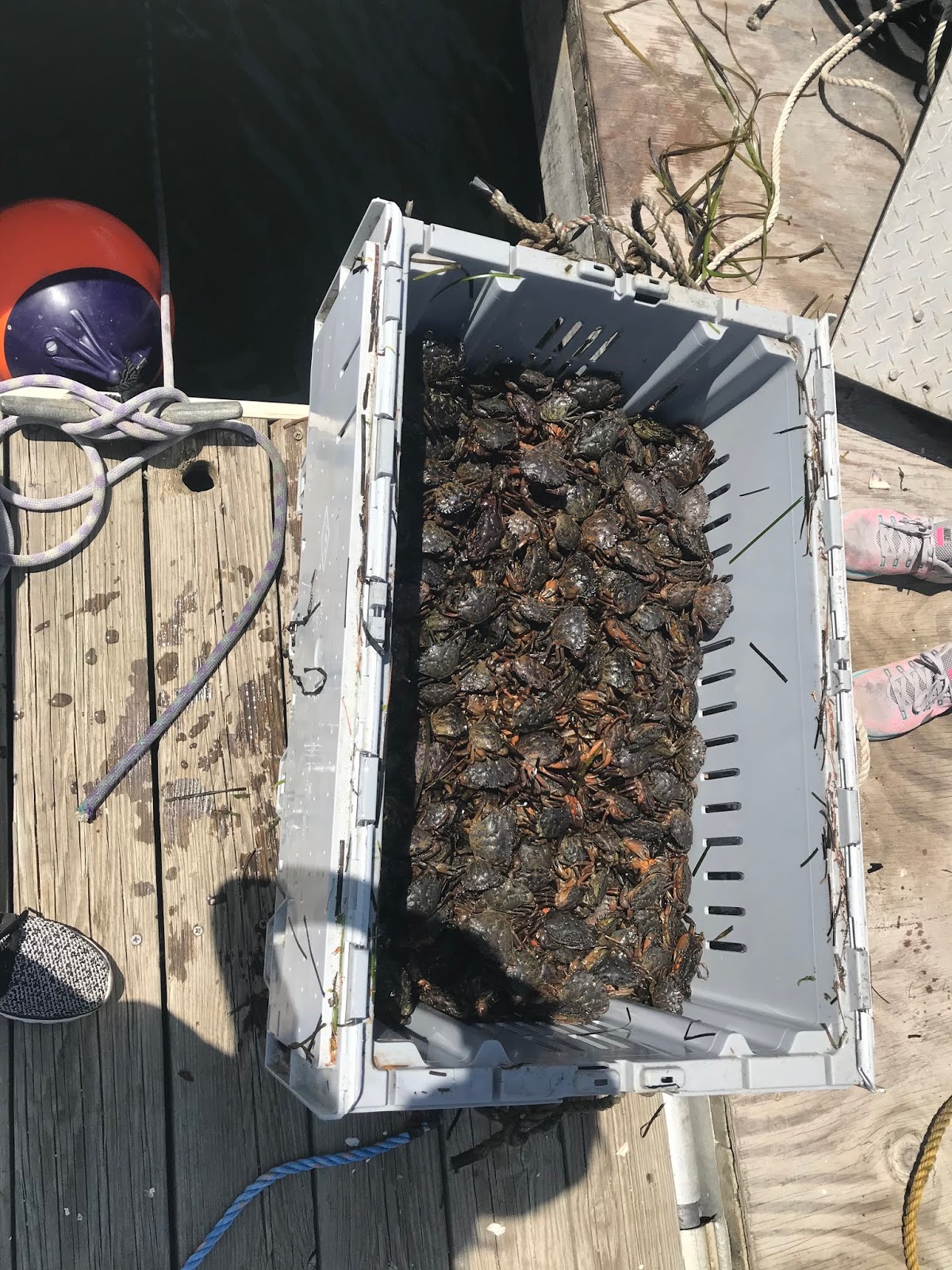
   We also recently went on the Great Bay Discovery Cruise thanks to Dari and Julia. It was a super neat and refreshing experience. We started off at the UNH pier in Newcastle, while out at a sea we caught some phytoplankton. Wow I knew there was a lot of phytoplankton but seeing hundreds in just one cup on water blew my mind. We eventually went up the bay and checked the temperatures, salinity, oxygen levels and a ton of different stuff. After that we went to Jackson Lab and Gabby talked about green crabs and just about anything you can think of.  While there I helped her intern with her recent green crab catches from today. Now I can say I've seen boxes with literally hundreds to thousand of crabs 🦀. I can't tell if I'm still intrigued or disgusted because my gosh did they smell bad. Well that wasn't the end of the cruise, we did some otter trawling afterwards and caught the biggest green crab I have ever seen. Probably the size of my face... We caught 2 flounders, so many crabs and different fish. Overall super cool experience and can't wait to do it again one day. Below are some photos I took on the cruise.


P.S. I don't have weird style when it comes to how I like the structure of my photos. I have yet to fully learn the quirks of this software.

Tuesday, July 3, 2018

Sand Dune Monitoring

Hey guys a lot has been happening since my last blog post and I haven’t been in the office much since! I have so much information to share and tons of great pictures too!

One project we have been doing is sand dune surveying at about 11 different different sites. This project is done every 3 months unlike beach profiling that is done every month. Dunes are dynamic but they are stable meaning they retain sand in the system unlike beaches where their profiles can change within hours during a storm. At these 11 sites each one has a rebar (a metal stake in the ground) that allows us to record data from the same exact location each time. With this stake in the ground we use a tape measure and create a straight line using a designated focus point. A laser is set up a few feet away from the rebar and we follow the measuring tape going towards the beach (positive) and away from the shore (negative). When there's a topographic change in we stop and collect the data. Using an adjustable meter stick that has a laser marker connected to it. One the laser marker meets the laser a loud beep occurs and we take the measurement. It’s quite fun to do and time flies once you get in the groove. But when the meter stick goes to it full height of 7 meters high, it gets quite hard and heavy to hold up when the wind is blowing. At our first site we had Peter Eisenhaure photograph us in action. And the photos came out amazing!


I also went to the NH Coastal Climate Summit and it was a big success! Representatives for Maggie Hassan and Jeanne Shaheen came to talk, so many scientist, researchers and experts in the field were there. They even had every day folks from Hampton talk about the challenges they face from storms and high tides in the winter. Two things that I thought were expressed the most were, one it’s only going to get worse and two living shorelines can truly help reduce the impact on structures and ecosystems from storms and flooding.


Friday, June 8, 2018

Second Week and Sand is Still in My Eyes

    Hey guys! So I'm onto my second week as an intern, but before I tell you about what I've been up to I want to give a shout out to Caitlin Mandeville and Alyson Eberhardt. They have been extremely helpful, knowledgable and amiable in this process and probably the coolest mentors I've had. 

   So back to what I've been doing. The first project I got started on was the American Eel Monitoring project and boy was I nervous. I have never dealt with eels and never touched one either but I put my science hat and went for it. It was definitely worth it and super cool. With this project we're right off Newmarket road at the dam, New Hampshire Fish and Game had already established a trap to catch and hold the eels. So a little more about the trap, the eels are able to swim up a wide pvc pipe into a bucket. That's when we come in, volunteers come out every morning Monday through Friday to do a count and measurement. This is where the fun happens, the bucket the eels are captured which sits in another bigger bucket to catch any overflow. So we have to use a small fish net to catch them again, checking both buckets just in case some are hiding in the overflow. Whatever eels we catch we put them in clove water. Yup clove water... clove water acts as an anesthesia for eels. Fun fact, if you get enough on clove on your finger it becomes numb. 
Eels penciling up in clove water


   You know the the eel is under anesthesia when they 'pencil up' because they become straight as a pencil. Once they pencil up we measure them and put them back in a bucket filled with river water and release them up stream. All data we record, whether they are brown, yellow or glass eels, what staged they are and how long they are, is recorded for NH Fish and Game. What's super interesting about the glass eels is that they come all the way from the Sargasso Sea in the vicinity of Bermuda. In about 20 years they can grow up to 5 feet long and once mature they swim back down to the Sargasso sea to spawn. I would have never thought I could talk about glass eels for a whole hour would become as interested as I currently am. There is so much back story behind glass eels, from the gold rush of glass eels to the million dollar profits fisherman were making and Jersey gangs. Check out this super interesting National Geographic article to learn more about glass eels and the political fire storm around it. 

     So another project we worked on was a sand dune restoration project and oh man I got a lot of sand in my eyes. To start off the project we went to the Hampton Beach State Park and planned on harvesting the beach grass from within the community beach garden. However when we got there we ended up not even having to harvest from inside the beach garden because of how successful the garden was. The beach grass ended up growing outside of the the designated area and onto the walking paths so we harvested that instead. Although that day when we harvested it was raining and a storm was coming in, the wind was unbelievably strong so we had to cancel part two which was the planting. When we did reschedule the day was absolutely perfect. Random people on the beach relaxing and hanging out offered to help which made the process go even faster. 


   It was amazing to see the volunteers show up consistently with a positive attitude always eager to help out and give back to their community. Numerous folks go out every week to collect data on eels, to help plant beach grass in dunes suffering erosion and families who saw us doing work in public areas and wanted to help out. It's always refreshing to see a community coming together. 


I never thought that I would ever be picking up eels just like I never thought I would be picking up crabs. Don't get me wrong I love my internship and I love dealing with animals and critter but there's a select few like eels, snakes, spiders, crabs that I am not too shabby for. But just like the eels I dealt with it and was picking up crabs in no time. I put my science hat on and did some crab hunting with a group of high school students and folks from the aquarium. Grabiela Bradt is a commercial fishery specialist and has been going out with volunteers at different locations to collect data on green crabs. Green crabs may not sound like they are special but they are super important because they are an invasive species. So no one knows what to do with these green crabs, besides them making a decent pet crab. Their shells are too hard, they don't become big enough to be worth eating, they eat whatever they want so they are taking food away from natives and they have no predators. Overall green crabs are pretty invasive and not much data has been collected on them. Which is why we stepped in and collected data from Adams point that has not had data collected from it before. 

Me holding a crab for the first time!!
So that's all for this blog post! I'll try to remember to continue taking photos!

~Tina


Thursday, May 31, 2018

A Little About Me

Hello everyone! I’m Kristina Gjergjaj but everyone calls me Tina. This upcoming fall I will be a junior studying Environmental Conservation and Sustainability at the University of New Hampshire. Sophomore year flew by at UNH but I am excited for the experiences and knowledge I will gain this summer. I have been given the opportunity to work with Alyson Eberhardt and Caitlin Mandeville t as the summer 2018 Coastal Resilience Intern for UNH Cooperative Extension and New Hampshire Sea Grant. For the next couple of weeks I will be taking part in numerous projects including beach profiling, sand dune restoration, glass eel monitoring then creating reports summarizing the data that was gathered. I am thrilled to be joining a team of like minded individuals and making a difference.
My main focus is to assist with data collection and volunteer training efforts in New Hampshire related to beach and sand dune restoration management. While developing reports to connect beach profiling data to management needs and stakeholders. With this opportunity I will gain skills in public communication and outreach, valuable experience in experimental design and experience with final reports.
So a little more about me, I grew up in Bronx New York and eventually moved to upstate New York. I have three younger siblings, I’m the oldest of 16 grandchildren and I can put a baby to sleep faster than you can say “supercalifragilisticexpialidocious.” Growing up consisted of my family and I constantly being outside, like when I lived in the city I would always ride my bike around the block or later on in the countryside planting 30 fruit trees, two gardens and exploring the state park behind my house. No matter where I lived I was always outside, since a young age nature has always been apart of my life.

When trying to figure out what I wanted to do with my life and where I wanted to continue my education. I had to pick out a major I knew I wouldn’t lose interest in and make a meaningful career out of it. The knowledge I was gaining from countless documentaries, the importance of the environment, how critical the quality of life is and that fact that I wanted to make a difference. When adding all four of my interests together, it made me realize what I wanted to study and do with my life. I wanted to save the environment. Saving the environment would have powerful endless effects on the world and generations to come. I wanted to learn the science behind protecting the environment and what it would take. Which is when I decided to go to the University of New Hampshire one of the top ten schools in the country for sustainability. Through this school I have gained field experience, knowledge of sustainability, strengthened my opinions and have been given numerous opportunities further my skills.
Stay tune for more updates!

~Tina

Tuesday, May 22, 2018

Welcome 2018 Doyle Fellows

New Hampshire Sea Grant would like to congratulate our new Doyle Fellows and Cooperative Extension Intern.

Audrey Berenson, a Biomedical Science: Medical Microbiology major at UNH, will work with Dr. Steve Jones on oyster farm sanitation practices. Collecting oysters and water samples in the Great Bay Estuary, testing for the presence of various bacteria, and working with oyster farmers will keep her busy.

Robert Lafrieniere, a Marine, Estuary & Freshwater Biology major at UNH, will work with Alyson Eberhardt and Caitlin Mandeville on evaluating the success of completed dune restoration activities. Developing a research study, monitoring coastal fieldwork, and participating in citizen science events will fill his summer.

Nicole DeRoche, a Biology major at Saint Anselm College, will work with Gabby Bradt on invasive green crabs in the Great Bay and Hampton Estuaries. Monitoring the molting cycle, recruiting and training volunteers, and working to develop a green crab fishery are only a few of the items on her to-do list.

As Coastal Resilience Intern, Krtistina will assist with data collection and volunteer training efforts related to beach and dune management in NH and will develop communications products to connect beach profiling data to management needs.

We look forward to working with and learning from our Fellows, as part of this unique exchange of knowledge and experience.

Visit our blog often and follow their stories this summer.